TikTok Creator Stardom [2026]: $44B Spend, 67% Under $10K
What Young Hollywood reported on November 8 · How the For You Page turns watch time into reach · Looze Cannon: a Michael Jackson act that reached Cordae and Timbaland · Addison Rae and the Netflix route · The earnings picture: 67% of creators made under $10,000 · From $13.9 billion to $44 billion: the ad money behind the stars · Logan Walter and the TikTok Shop income model · Mid-tier creators are running real businesses · What creators and commentators say about TikTok fame · TikTok’s own push into entertainment and commerce · The regulatory question hanging over the FYP · Four routes to fame compared · Render settings for a TikTok-first video · Five predictions for creator-led stardom · Common questions
The TikTok creator has become the entry point to fame for a growing share of performers, and a Young Hollywood article published on November 8, 2026 (updated November 9) lays out how that works. The piece describes TikTok as an algorithm-driven talent showcase that sits beside, and sometimes ahead of, the studios, labels and networks that used to hand out celebrity.
The story is part cultural and part commercial. Young Hollywood points to Looze Cannon, a performer with more than 1 million followers, and to Addison Rae, who moved from short clips to a multi-picture Netflix deal. A separate November 2026 report adds the money side: ad spending on creators is climbing, yet most creators earn little.
This analysis covers what each source actually says, where the numbers stop, and what it means for anyone shooting vertical video. For the file-level side of the same topic, our guide to TikTok video size rules for organic posts and ads covers upload dimensions in detail.
What Young Hollywood reported on November 8
Young Hollywood published “How TikTok Creator Culture Is Redefining Modern Stardom” on November 8, 2026 and updated it a day later. Its core argument is simple. TikTok works as an alternative to traditional Hollywood gatekeeping, and its recommendation system acts as a talent showcase that does not need an agent to open the door.
The article says the platform increasingly acts as a direct audience-to-talent pipeline for vocalists, dancers, comedians and visual artists. It also says casting agencies, music labels and brand executives reportedly watch TikTok for creators who already have an engaged audience. The hedge matters, because the piece does not name specific casting directors or labels that scout there.
The shift Young Hollywood describes is a change in who confers celebrity. Instead of a studio, label or network choosing talent and then building an audience, the audience arrives first and the industry reacts. Measurable reach becomes the audition tape.
One caution applies from the start. The sources reviewed here do not establish that TikTok has replaced Hollywood agencies, casting directors or the wider celebrity system. They show a new route, not a closed old one. We checked these claims against the Young Hollywood piece and the separate report on November 9, 2026.
How the For You Page turns watch time into reach
Every TikTok story starts with the FYP, short for For You Page. Young Hollywood says the system recommends content using watch time, likes, shares and comments. Because the feed is built on those signals rather than on who follows whom, a new account can reach viewers far outside its existing audience.
The four signals Young Hollywood names
- Watch time: how much of a clip viewers actually sit through.
- Likes: the lightest form of approval.
- Shares: a viewer sending the clip onward, which pulls in new people.
- Comments: a sign the clip started a conversation.
What the signals do not tell you
Young Hollywood names the signals but publishes no formula and no weighting. Nothing in the available sources says how much a share counts against a comment, or how long a clip must run to score well. Treat any guide that claims exact numbers as a guess.
For video makers, the practical reading is about the first seconds and the finish. A clip people watch to the end and send to a friend does more work than one that collects a quick like. That is a craft point about openers and pacing, not a secret setting.
Looze Cannon: a Michael Jackson act that reached Cordae and Timbaland
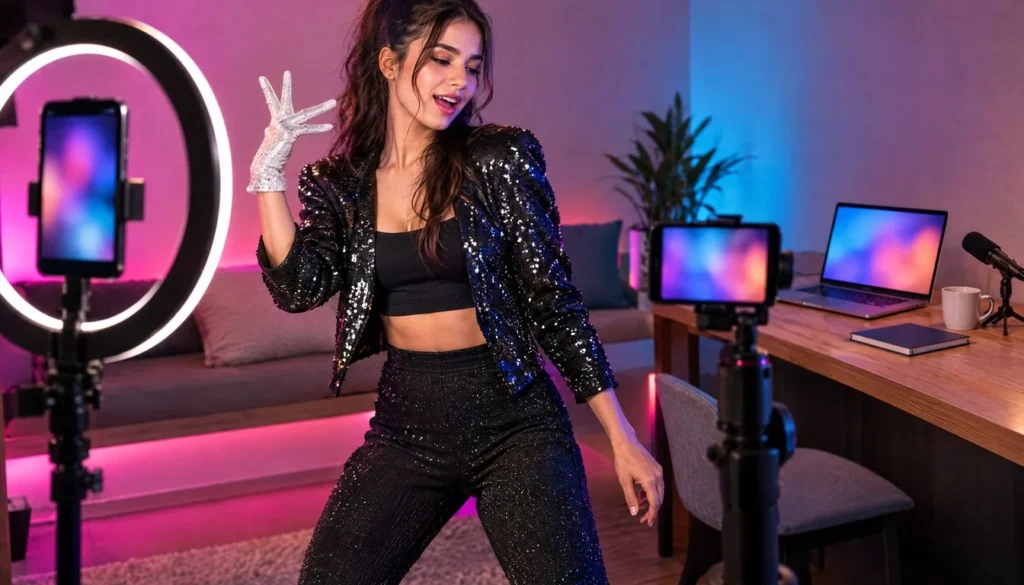
Young Hollywood uses Looze Cannon as its main example of discovery-first fame. He has passed 1 million TikTok followers, and the article ties that following to Michael Jackson impersonations, dance and humor. The piece says his visibility drew attention from Cordae and Timbaland.
Two details stand out. First, the act is a format, an impersonation, that fits a short vertical clip and can be recognized in a second or two. Second, the attention from established music names came after the audience existed, not before. The follower count did the introducing.
The sources do not say what business came out of those contacts, so none is claimed here. A mention of interest from Cordae and Timbaland is evidence of notice, not of a contract, a release or a tour. Anyone reading the story as a guaranteed ladder is reading more than the article states.
Addison Rae and the Netflix route
Addison Rae is the better-known version of the same path. Young Hollywood says she moved from TikTok into acting, including He’s All That, and later landed a multi-picture deal with Netflix. In the article’s framing, her following worked as audience validation that a studio could read.
That framing is the useful part. A studio deciding on a first-time lead normally has few data points. A creator arrives with watch history, engagement and a demographic already attached. The follower count lowers the perceived risk, which is a business logic more than a talent verdict.
The article also adds a limit that is easy to skip. Virality alone does not guarantee a durable career. TikTok can supply proof of concept through audience size, engagement, repeat viewing and cultural reach, but the move into film, music or television still has to be won on other terms.
The earnings picture: 67% of creators made under $10,000
The headline numbers come from a separate November 2026 report that cites CreatorIQ and the IAB. The table sets them out as the report presents them. We did not find a primary CreatorIQ or IAB publication to confirm the figures independently, so read them as reported data.
| Measure | Figure | Cited source |
|---|---|---|
| Creators who earned less than $10,000 from content in the preceding year | 67% | CreatorIQ, via the November 2026 report |
| Creators who earned more than $100,000 | Fewer than 5% | CreatorIQ, via the November 2026 report |
| Creators for whom content is not the primary income | 62% | CreatorIQ, via the November 2026 report |
| U.S. creator advertising spend, 2021 | About $13.9 billion | IAB, via the November 2026 report |
| U.S. creator advertising spend, 2026 | Roughly $44 billion | IAB, via the November 2026 report |
| Logan Walter earnings over two years (age 21) | Reportedly more than $1 million | The November 2026 report |
Read the first three rows together. Two thirds of creators earned under $10,000, fewer than one in twenty topped $100,000, and for 62% the work was not even the main paycheck. Stardom is real, but it is a thin slice of a very large field.
From $13.9 billion to $44 billion: the ad money behind the stars
The IAB figure cited in the report puts U.S. creator advertising spending at about $13.9 billion in 2021 and roughly $44 billion in 2026. That is a gain of about $30 billion, or a bit more than triple the 2021 level, in five years. Brands now treat creators as a media channel with its own budget line.
History helps here. A decade ago, a brand deal for a social video maker meant a one-off post fee, often negotiated by hand. The 2021 baseline sits at the point when short-form video went mainstream, and the jump since then shows how fast ad dollars followed attention.
The mismatch is the story. Spending tripled, yet the CreatorIQ data shows most creators still earn modest sums. The money concentrates in a small group, which is how an attention market behaves once a few accounts reach scale. Anyone budgeting a creator career should plan around the 67%, not the 5%.
Logan Walter and the TikTok Shop income model
The November 2026 report names Logan Walter, 21, as a creator who reportedly earned more than $1 million over two years through TikTok Shop and brand deals. The figure comes from that single report and the sources reviewed here do not break it into shop sales versus sponsorships.
What the example shows is a different kind of fame. Walter’s income, as described, comes from selling and endorsing, not from a film role or a record deal. In that model the creator is a distribution channel, and the video is the storefront.
TikTok has leaned into the same idea. According to TikTok’s newsroom, a TikTok Shop holiday program for U.S. shoppers was scheduled to run November 11 through November 30, 2026, covering Black Friday and Cyber Monday. TikTok also reported that holiday-shopping content using #holidayshopping grew 263% in September versus the previous month. Both claims rest on a single source, so treat them as TikTok’s own framing, not independent measurement.
Mid-tier creators are running real businesses
Dan Albert of 456 Growth said mid-tier creators are “now running real businesses.” The line captures where the CreatorIQ numbers leave a gap. Between the 67% under $10,000 and the sub-5% above $100,000 sits a middle group that treats content as a company, with product lines, sponsors and repeatable output.
For video production, that business view changes what a creator buys. Consistent branding, a reusable opener, captions on every clip and a clean export workflow cost time but pay back across hundreds of uploads. Our look at auto captions in five editors covers one of the cheapest upgrades a small channel can make.
The sources do not give Albert’s revenue thresholds, so there is no tidy definition of mid-tier here. The takeaway is directional. The creator economy has a professional middle, and it earns through steady output rather than a single viral hit.
What creators and commentators say about TikTok fame
The four statements below come from earlier coverage, a Wall Street Journal podcast episode on how TikTok became the world’s favorite app and an Interview magazine feature on TikTok fame. They predate this week’s reporting, so read them as background on how people inside the culture describe it, not as comments on the Young Hollywood piece.
Creator and creator-economy commentator Christen Nino De Guzman said on the Wall Street Journal podcast: “Anyone could find an audience if they were entertaining and produced interesting content.” She added: “What struck me was that it often only took one video for many to gain a following that would have taken years on other platforms.”
In the same episode she described the shift in Hollywood terms: “The creator economy was transforming due to TikTok, and we saw individuals in their kitchens in Ohio becoming superstars, signing with Hollywood agencies and rising to fame.” Her description lines up with the Addison Rae route, though it is one commentator’s account, not a measured rate.
Musician and producer Diplo told Interview magazine: “The For You page on TikTok is the best movie ever made and they make it every day.” The comment treats the FYP as a nonstop production, which suits a platform where the algorithm, not an editor, programs the screen.
TikTok’s own push into entertainment and commerce
TikTok’s recent announcements point the same way as the Young Hollywood story. On October 14, 2026, TikTok reportedly announced a partnership with MADE BY US STUDIOS to co-produce creator-led vertical micro-series for TikTok and PineDrama. The first project, Player, is scheduled to premiere on both on November 19, 2026, according to that announcement.
Creator recognition is also becoming formal. TikTok’s newsroom reported the 2026 UK TikTok Awards on November 5 with 79 creators across 13 categories, including a TikTok Shop founder award, and voting set to close November 18. On the business side, reports say TikTok introduced Creator AI Search inside TikTok One on October 7, a tool for brands and agencies to find creator talent.
These items come from single sources, so none is presented here as independently confirmed. Together they suggest the platform wants to be the place where a creator is found, hired, paid and credited. That ambition is TikTok’s stated direction, not proof that traditional studios are losing ground.
The regulatory question hanging over the FYP
The same recommendation engine that makes stars is under scrutiny. Reports dated November 6, 2026 say the European Commission issued preliminary findings that the For You system may breach the Digital Services Act by creating harmful rabbit holes for users. The findings are preliminary, and no algorithm change was announced.
For creators, the lesson is about dependency. A career built on one platform’s recommendation system inherits that system’s regulatory risk. If rules ever reshape how the FYP recommends content, the signals Young Hollywood lists could matter differently, and the creators who own their audience elsewhere would feel it less.
Nothing in the reviewed sources says that outcome is coming. It is a risk to weigh, and it fits a broader pattern: video platforms set the rules, creators build on them, and the platform keeps the ability to change them.
Four routes to fame compared
The table puts the cases from this story side by side. It uses only what the Young Hollywood article and the separate November report state.
| Case | What the audience built | What came next | Source |
|---|---|---|---|
| Looze Cannon | More than 1 million followers via Michael Jackson impersonations, dance and humor | Attention from Cordae and Timbaland | Young Hollywood |
| Addison Rae | A large TikTok following | Acting in He’s All That, then a multi-picture Netflix deal | Young Hollywood |
| Logan Walter | A commerce-focused audience at age 21 | Reportedly more than $1 million over two years from TikTok Shop and brand deals | November 2026 report |
| Mid-tier creators | Steady, repeatable output | Businesses, per Dan Albert of 456 Growth | November 2026 report |
| Casting agencies, labels, brands | Scouting for engaged audiences | Reportedly monitor TikTok for talent | Young Hollywood |
Three of the five rows end in an outside industry, music, film or advertising, picking up a creator who already had reach. That is the pattern the headline claims. It is also the full extent of the evidence, which is a handful of named cases, not a census.
Against other platforms, the difference is the discovery layer. Our comparison of Reels, TikTok and Shorts specs shows the three vertical feeds share nearly the same frame, so creators can reuse one master file. The reach mechanics differ more than the pixels do.
Render settings for a TikTok-first video
If the route to stardom runs through vertical clips, the export matters. The table below lists what third-party 2026 guidance recommends, checked November 9, 2026. The search results did not surface a TikTok official page confirming every spec, so confirm against TikTok’s own upload documentation before you publish a batch.
| Setting | Reported value | Status |
|---|---|---|
| Resolution | 1080 x 1920 pixels | Third-party 2026 guidance |
| Aspect ratio | 9:16 | Third-party 2026 guidance |
| Container and codec | MP4 with H.264 | Third-party 2026 guidance |
| Maximum upload length | Not verified in these sources | Check TikTok’s help center |
| Maximum file size | Not verified in these sources | Check TikTok’s help center |
One trap deserves a flag. A 256 GB and 12-hour limit appears in some search results, but it belongs to YouTube, not TikTok. Our YouTube video size guide covers that platform separately, and the full set of platform video specs sits in one category.
If a render comes out too large, re-encoding is usually the fix. Our walkthrough on how to reduce video file size compares codecs and tools. From the Vipid archive: the intro themes page lists resolution, length and frame rate for each theme, which helps when you match a branded opener to a vertical master.
Five predictions for creator-led stardom
These are analysis, not reported facts. Each follows from the sources above and carries no date or number the sources do not support.
- Studios will keep treating follower data as a risk filter. The Addison Rae pattern suggests audience proof lowers perceived risk, so expect more deals that start from an existing following.
- The earnings gap will persist. With 67% under $10,000, a rising ad pool does not by itself lift the median creator. Concentration is the likelier outcome.
- Commerce will matter more than fame for many creators. Logan Walter’s reported income and TikTok’s Shop programs both point to selling as the steadier model.
- Platform tools will formalize creator discovery. Creator AI Search in TikTok One and the new award categories suggest hiring and recognition moving inside the app.
- Regulation will test the FYP’s role. The preliminary EU findings are an early signal. The outcome is open, and creators who spread across platforms hold less risk.
Common questions
What did Young Hollywood say about TikTok creator culture?
Its November 8, 2026 article, updated November 9, argues that TikTok works as an alternative to traditional Hollywood gatekeeping. It credits the FYP and its watch time, like, share and comment signals for helping creators reach new audiences.
How many TikTok creators actually earn a living?
According to CreatorIQ data cited in a November 2026 report, 67% of creators earned under $10,000 in the preceding year and fewer than 5% earned over $100,000. For 62%, content was not the primary income.
Has TikTok replaced Hollywood talent agencies?
The sources reviewed do not show that. They show agencies, labels and brands reportedly watching TikTok, and cases such as Addison Rae moving into film. That is a new pipeline beside the old one.
What does the IAB figure say about creator advertising?
The report cites an IAB figure of about $13.9 billion in U.S. creator advertising spend in 2021 and roughly $44 billion in 2026. That is a bit more than triple the 2021 level.
What export settings do third-party guides recommend for TikTok?
Third-party 2026 guidance points to 1080 x 1920 pixels, a 9:16 ratio and MP4 with H.264. The sources did not confirm TikTok’s upload length or file size cap, so check the official help center.
Does a viral video guarantee a lasting career?
No. Young Hollywood states that virality alone does not guarantee a durable career. TikTok can supply proof of concept through audience size, engagement, repeat viewing and cultural reach, and the rest has to be built.
Who is Logan Walter?
A separate November 2026 report names him as a 21-year-old creator who reportedly earned more than $1 million over two years through TikTok Shop and brand deals. The figure comes from that report alone.
- Vipid intro themes resolution, length and frame rate per theme
- Promo themes product and channel promos
- Sample videos finished Vipid intros
- Vipid intro maker make a custom intro in the browser
Jonah Reyes
Jonah Reyes is the Editing & Export Editor at Vipid. He covers editing software, export settings and codecs, and the video specs of YouTube, Shorts, TikTok and Reels, plus OBS and screen recording. He builds Vipid’s spec tables from the platforms’ own documentation and re-checks them every 60 to 90 days, so the numbers in a guide match what the upload dialog actually accepts.